
Sources: U.S. DOE Building America Solution Center (updated 2021), Florida Building Code, Residential R401.3 (2023), USGS Water Science School (2019).
The best downspout drainage ideas all do one job: they carry roof water far enough from the house that it can't soak the soil at the foundation. On a Tampa Bay home that means at least 5 feet away, on ground that keeps falling away from the walls. Below are eight options, from a splash block you can set down today to a buried pipe that empties at the street, with what each one handles and where it falls short.
We install downspout drainage across Tampa Bay, so this guide leans on Florida conditions: flat lots, sandy soil, a high water table and summer storms that drop inches of rain in an afternoon.
Contents
- Why downspouts matter more in Tampa Bay
- How far should downspouts drain from a house?
- 8 downspout drainage ideas, simple to buried
- Downspout drainage options compared
- Is it a good idea to bury downspouts underground?
- Mistakes to avoid
- When to call for downspout drainage
- FAQ
Why downspouts matter more in Tampa Bay
A roof turns a wide area of rain into a few narrow streams. The U.S. Geological Survey puts one inch of rain on an acre at about 27,154 gallons. Scaled down, that is roughly 623 gallons off every 1,000 square feet of roof for each inch that falls, and all of it leaves through the downspouts.
Tampa gets a lot of those inches, and most of them come at once. NOAA's 1991 to 2020 normals for Tampa International Airport show 49.48 inches of rain a year, with about 30 of those inches falling from June through September. August alone averages 9.03 inches.
| Roof area draining to one downspout | Water from a 1-inch rain | Water in an average Tampa August (9.03 in.) |
|---|---|---|
| 250 sq ft | about 156 gallons | about 1,410 gallons |
| 500 sq ft | about 312 gallons | about 2,810 gallons |
| 750 sq ft | about 468 gallons | about 4,220 gallons |
| 1,000 sq ft | about 623 gallons | about 5,630 gallons |
Our math from the USGS rain-per-acre figure and NOAA 1991 to 2020 normals for Tampa International (National Weather Service Tampa Bay).
Most homes here sit on a concrete slab or over a crawl space, not a basement. So the damage looks different from the northern guides. Water that dumps at the wall soaks the soil at the slab edge, washes sand out from under walkways, and finds its way into a crawl space.
Much of Tampa Bay also has a high water table, so the ground near the house is often already wet before the storm starts. That is why getting roof water away from the house matters so much here, and why it pairs with foundation waterproofing on homes that already show moisture.
How far should downspouts drain from a house?
At least 5 feet, and farther when the water goes into the ground. The U.S. Department of Energy's Building America Solution Center says downspouts should end at least 5 feet from the foundation, with the pipe pitched away at a minimum of 5/8 inch per foot. When downspouts feed an underground catchment such as a dry well, it should sit at least 10 feet from the foundation.
The ground has to help too. Florida's residential building code (Section R401.3) says lots must be graded to drain water away from foundation walls, with a fall of at least 6 inches within the first 10 feet. Where a lot line, wall or slope makes that impossible, the code calls for drains or swales to carry water away instead. Hard surfaces within 10 feet of the house, like a patio or pool deck, must slope at least 2 percent away from the building.
Many Tampa Bay lots are close to flat. If your yard can't give you that 6 inches of fall, sending downspout water 5 feet out onto level ground just moves the puddle. That is when a pipe to a lower outlet earns its cost.
8 downspout drainage ideas, from simple to buried
These run from the cheapest and easiest to the most permanent. Simple ideas suit a downspout that drains a small roof area onto a yard that already slopes away. Buried ones suit flat lots, big roof areas and downspouts that empty onto a walkway or patio.
1. Splash block
A splash block is a concrete or plastic tray under the downspout elbow. It stops the stream from digging a hole, but it only moves water a foot or two. Building America treats it as an erosion guard at the end of a longer pipe, not as drainage on its own. On its own it is only enough where the ground already falls away hard.
2. Downspout extension
A rigid or flexible extension clipped to the elbow can carry water past the 5-foot mark for very little money. The trade-offs are practical: extensions get kicked, run over by mowers and moved by landscapers, and a flexible one that sags will hold water. Use one where the yard slopes away and nobody walks.
3. Rain barrel
A rain barrel catches water for the garden. UF/IFAS Extension in Sarasota County runs rain barrel workshops and says a 55-gallon drum works best.
The catch in Florida is volume. By the numbers above, a downspout draining 500 square feet of roof fills a 55-gallon barrel in less than a quarter inch of rain. After that, the overflow needs its own path away from the house, so treat a barrel as a garden supply, not a drainage fix.
4. Rock-lined swale or dry creek bed
A shallow channel lined with river rock can carry downspout water across the yard and looks like landscaping. It works when the channel keeps falling the whole way and empties somewhere that can take the water. A swale is also one of the fixes Florida's code names for lots that can't get the standard slope. On a dead-flat lot, though, rock just holds a puddle that looks nicer.
5. Buried pipe to a pop-up emitter
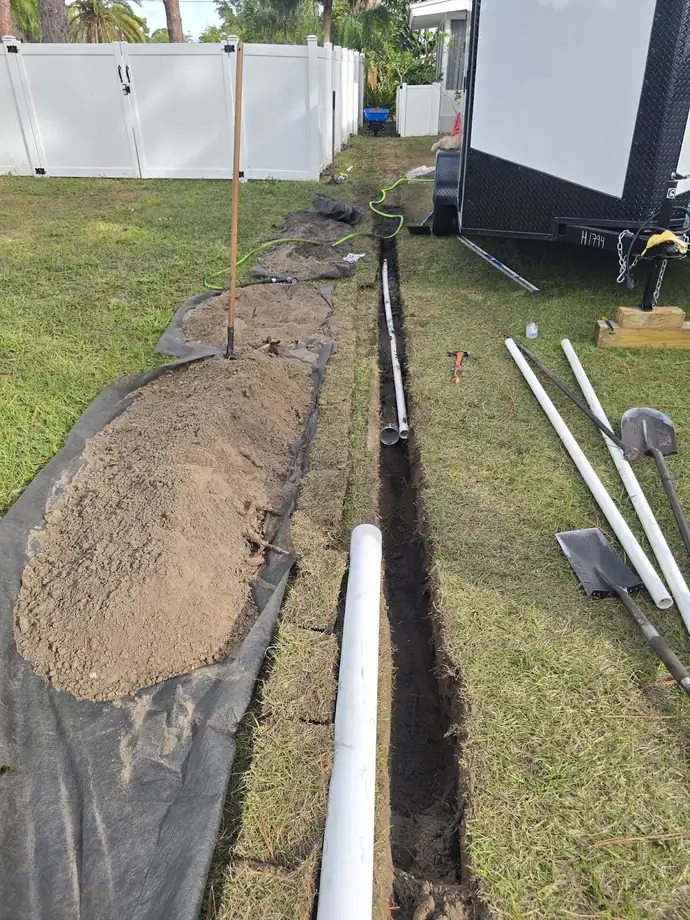
This is the most common buried downspout drainage idea. A solid pipe runs from the downspout under the lawn to a pop-up emitter, a small cap that opens when water pushes up and closes again when the flow stops, which keeps animals out. Building America calls for a non-perforated pipe sloped at least half an inch per foot away from the home for at least 10 feet. We use Schedule 40 PVC for these runs, and set gravel around the outlet so the discharge point doesn't wash out.
6. Catch basin at the downspout
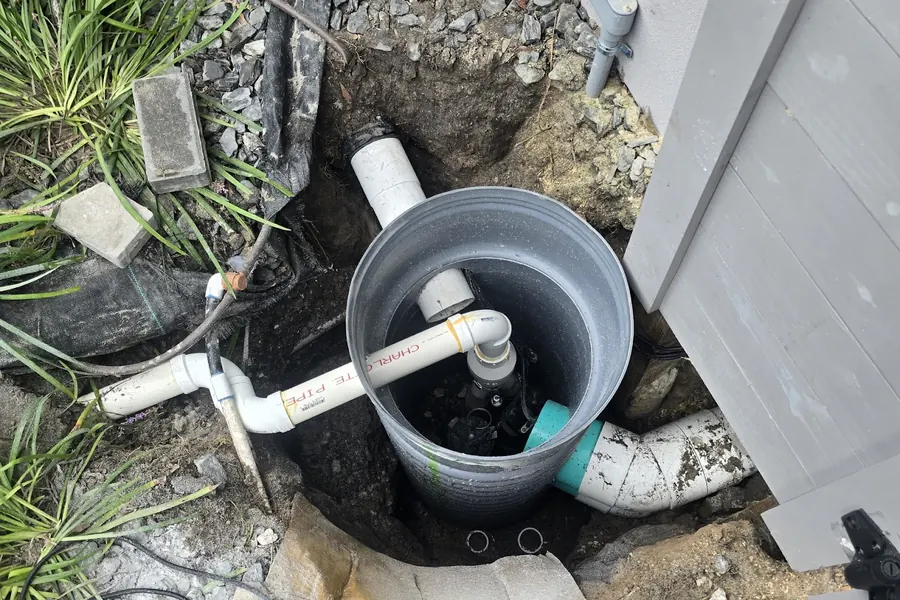
Instead of piping straight from the elbow, the downspout drops into a catch basin, a box with a removable grate. Debris settles out in the basin, you can clean it from the top, and one basin can also collect surface water from a low spot next to the house. Several basins can share one main pipe, a common layout when a house has three or four downspouts on one side. If the low spot is bigger than the area around one downspout, that becomes a yard drainage job.
7. Tie into a channel drain on a patio or pool deck
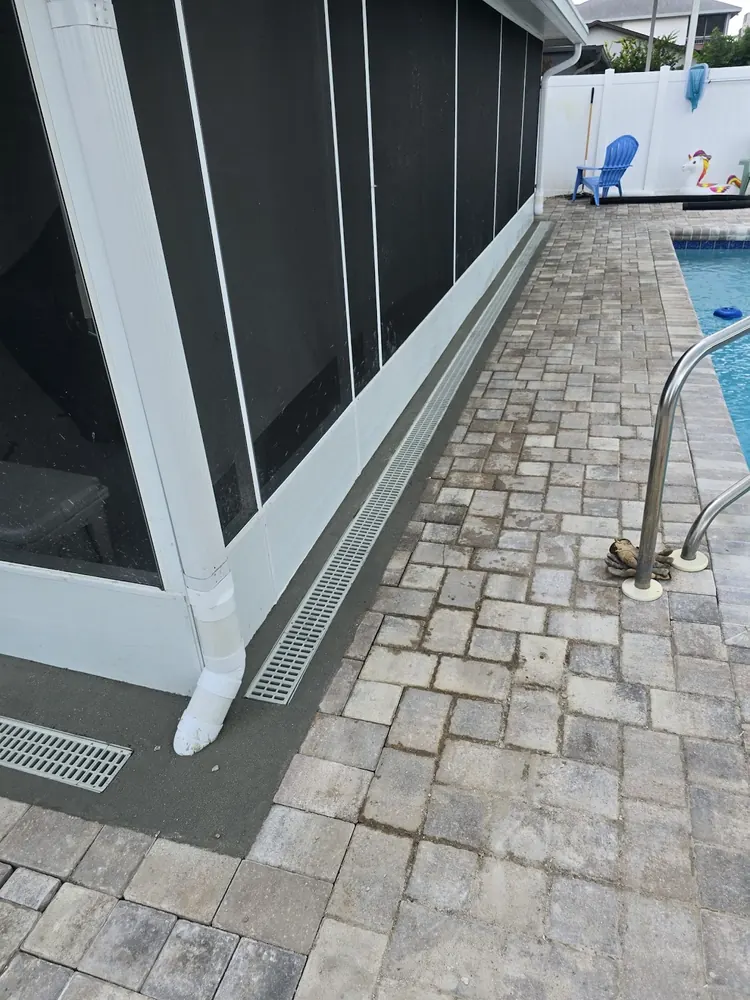
On Florida homes, downspouts often come down onto a pool deck or a paver patio inside or beside a screen enclosure. There is no lawn to pipe across, and the water sheets toward the house or the pool. A channel drain set into the deck can catch both the downspout and the deck runoff and carry them underground to an outlet.
8. Dry well, street or low-point discharge
Every buried system has to end somewhere. The usual choices are the street, a low point in the yard far enough from the house, or a dry well, a buried chamber that holds water and lets it soak in.
Florida's code says surface drainage must go to a storm sewer or another approved point that does not create a hazard, and Building America puts an underground catchment at least 10 feet from the foundation. A dry well also depends on soil that can absorb water. Where the water table is high, it may already be full when you need it, so the outlet choice is a site-by-site call. If you plan to pipe to the curb, check with your city and HOA before you dig.
Downspout drainage options compared
| Option | Moves water | Best for | Watch for |
|---|---|---|---|
| Splash block | 1 to 2 ft | Yards that already slope away hard | Not enough on its own on a flat lot |
| Extension | 5 ft or more | Side yards nobody walks through | Mowers, trip hazard, sagging |
| Rain barrel | Stores 55 gal or so | Garden water | Overflow still needs a path |
| Rock swale | As far as it slopes | Yards with some fall to work with | Holds water if the run is level |
| Buried pipe + emitter | 10 ft and beyond | Lawns, flat lots, larger roofs | Needs steady slope and a good outlet |
| Catch basin + shared pipe | Wherever the pipe goes | Several downspouts, low spots by the house | Clean the basin grates |
| Channel drain tie-in | Wherever the pipe goes | Pool decks, patios, screen enclosures | Must be set to the deck's slope |
| Dry well / street / low point | The end of the line | Every buried system needs one | Water table, soil, local rules |
Is it a good idea to bury downspouts underground?
Usually yes, when it's built right. A buried line is out of the way, won't get run over, and can carry water as far as it needs to go. That makes it the best way to disperse water from a downspout on a flat Florida lot, because it can reach a lower outlet that a surface option can't.
It goes wrong in three ways.
- A pipe laid without steady fall holds water and sediment.
- A pipe with no outlet that can take the water backs up into the gutter during a storm.
- A pipe with no cleanout point is hard to clear when leaves and roof grit build up.
Building America's guidance covers the first two: non-perforated pipe, at least half an inch of fall per foot, and a discharge point well away from the house.
The best pipe for downspout drainage is a smooth, solid one. Building America allows smooth or corrugated plastic as long as it is non-perforated. Smooth pipe is easier to clean, which is why our crew lays Schedule 40 PVC.
Mistakes to avoid
- Draining downspouts into a perforated foundation drain. Building America warns this "will soak the foundation." Roof water belongs in a solid pipe of its own.
- Using perforated pipe for the downspout line. The water leaks out along the way, often right next to the house where the line starts.
- Ending the line at the neighbor's fence. Florida's code says drainage must go somewhere that does not create a hazard. Your neighbor's yard isn't that.
- A level or bellied run. A pipe that dips holds standing water and silt, and slowly clogs.
- Ignoring the slope by the house. If the soil or pavers tilt toward the wall, water comes back no matter where the downspout ends.
When to call for downspout drainage
A simple fix is fine when a downspout drains onto a yard that slopes away. Call a drainage installer when you see water standing against the foundation after storms, washouts under the downspouts, a wet crawl space, or a downspout that empties onto a patio or pool deck with nowhere to go. Those are the cases where the water needs a pipe and a proper outlet.
Our downspout drainage service covers homes across Tampa Bay, including St. Petersburg, Clearwater, Largo, Dunedin, Tampa, Brandon, New Port Richey, Bradenton and Lakeland. On a free estimate we look at where each downspout empties, how the yard falls and where the water can go, then send a written estimate. Use the form on this page or call (727) 291-9950.
FAQ
What is the best way to disperse water from a downspout?
Carry it at least 5 feet from the foundation, and farther on a flat lot, to ground that keeps falling away from the house. On most Tampa Bay lots that means a solid buried pipe to a pop-up emitter, a low point, the street or a dry well. Splash blocks and extensions only work where the yard already slopes away.
How far should downspouts drain from a house?
The U.S. Department of Energy's Building America guidance says at least 5 feet from the foundation, and at least 10 feet when the water goes into an underground catchment like a dry well. Florida's building code also asks for the ground to fall at least 6 inches in the first 10 feet from the house.
Is it a good idea to bury downspouts underground?
Yes, if the pipe is solid, slopes steadily away from the house and ends at an outlet that can take the water. A buried line stays out of the way of mowers and foot traffic. A level run, perforated pipe or a blocked outlet will cause backups instead.
What do you put at the bottom of a downspout?
For surface drainage, a splash block or an extension. For buried drainage, a downspout adapter into a solid pipe or a catch basin with a removable grate, so debris can be cleaned out from the top.
What is the best pipe for downspout drainage?
A smooth, solid, non-perforated pipe. Building America allows smooth or corrugated plastic as long as it is non-perforated. We use Schedule 40 PVC because the smooth wall flows well and is easier to clear.
Can downspouts drain into a perforated drain pipe?
It's not recommended. Building America warns that connecting the gutter drain pipe to a perforated foundation drain will soak the foundation. Give roof water its own solid pipe to an outlet away from the house.